Water softeners & filtration
Water Softener Installation & Filtration in Ottawa
Scale, staining or an unwanted taste? Start with your water source and a test, not a bigger filter. Ask Plumber Ottawa about water softener installation, filtration and the plumbing work your home actually needs.
- Treatment matched to test results
- $150 water test with conditional credit
- Municipal and private-well considerations
- Installation and maintenance questions
Get a fast plumbing quote
Tell us what's wrong — we'll call you back in minutes.
- Licensed & insured
- Upfront flat-rate pricing
- Workmanship guarantee
- Clean, respectful techs
- Same-day service
Quick answer
Do you need a water softener in Ottawa?
Not automatically. Ottawa's central municipal supply is generally soft, while private wells and other local supplies can have different characteristics. Confirm the supply serving your address and measure hardness before choosing a softener. A softener addresses calcium and magnesium; it is not a substitute for disinfection or a filter certified for a particular contaminant. Plumber Ottawa's water test costs $150, credited toward the job if the results show treatment or cleaning is needed.
What we fix
Match the symptom to the right investigation
Several different problems can look like hard water. Describe what changed, which fixtures are affected and whether the problem is present in hot water, cold water or both.
Scale on taps and appliances
Mineral deposits can justify a hardness measurement, but appearance alone does not establish the chemistry. Compare a sample from the untreated supply with water after existing equipment before deciding to add or replace a softener.
Taste or chlorine odour
A carbon filter may help with an aesthetic concern when suitable for the water and its intended use. Taste is not a safety test, and sudden changes should be investigated rather than hidden behind a new cartridge.
Particles or cloudy water
A sediment filter captures particles within its rated capability. Cloudiness can have other causes, including air. Note whether it clears in a glass and ask about the source before choosing a finer filter that could restrict flow.
Orange or dark staining
Iron and manganese are possibilities, not a diagnosis. Laboratory results, water chemistry and the equipment specification determine whether dedicated treatment is appropriate. A standard softener should not be assumed to handle every staining problem.
An existing system stops working
Record the model, maintenance history, displayed errors and recent changes. Exhausted media, an overdue cartridge, valve problems or a bypass left open can change performance. Investigation may identify a repair rather than a complete replacement.
Questions about a private well
Private-well owners need a testing plan that separates bacteria from chemical and mineral concerns. A plumbing visit does not certify drinking-water safety. Use public-health and laboratory guidance to decide what to test and what treatment is needed.
Compare your options
Water softener, filter or disinfection: what is the difference?
Choose equipment by the problem it is designed and certified to address. Some homes need no new treatment; others need more than one stage selected from actual results.
| Option | Main purpose | Important limitation | Before you choose |
|---|---|---|---|
| Ion-exchange softener | Reduce calcium and magnesium hardness | Does not disinfect water; sodium-based units add sodium | Measure hardness, household flow and treatment capacity |
| Sediment filter | Capture suspended particles | Not a general solution for dissolved substances or bacteria | Confirm particle source, micron rating and pressure loss |
| Activated carbon | Address specified taste, odour or certified reductions | Performance depends on the exact product and maintenance | Check the model's certified claims and cartridge life |
| Reverse osmosis | Reduce selected dissolved substances at a drinking-water tap | Not every system covers every contaminant; produces reject water | Compare certified reductions, feed-water requirements and servicing |
| Ultraviolet treatment | Inactivate microorganisms under suitable operating conditions | Does not remove minerals; requires appropriate water quality and maintenance | Follow public-health advice and the equipment's pretreatment requirements |
| No additional treatment | Keep a suitable existing supply and plumbing | Does not resolve a confirmed quality or equipment problem | Review results before buying equipment unnecessarily |
How it works
From water concern to an informed installation decision
- 1
Describe your supply
Tell us your neighbourhood, municipal or well supply, symptoms and any equipment already installed.
- 2
Agree on testing
Confirm what the $150 water test includes and whether separate laboratory tests are needed for your concern.
- 3
Review the results
Compare the measured problem with treatment options, including cleaning, repair or no equipment purchase.
- 4
Discuss the quote
Ask about installation scope, space, drainage, bypass valves, ongoing costs and available appointments.
- 5
Plan maintenance
Keep model details, service instructions and testing records so performance can be checked after installation.
Upfront pricing
What does water treatment cost in Ottawa?
The water test is $150. If the results show treatment or cleaning is needed, the $150 is deducted from that job. If no treatment or cleaning is needed, the test remains $150. Ask what the assessment measures before booking; do not assume it includes every chemical analysis or a public-health laboratory sample.
An installation price depends on the chosen equipment, capacity, existing pipework, access, drainage and any electrical work. There is no verified fixed softener installation price on this page. Compare the equipment price with the complete installed scope and ongoing consumables, rather than treating the lowest advertised unit price as the final bill.
Use our Ottawa plumber rates guide for broader planning ranges, not as a guaranteed water-treatment quote. A small travel fee may apply to rural addresses. Ask whether HST, cartridges, salt, delivery, removal of old equipment and any separate laboratory work are included in your proposed price.
- $150 water test
- $150 credited if treatment or cleaning is needed
- No credit promised for an unrelated repair
- Confirm laboratory testing scope separately
- Ask for equipment and installation inclusions
- Discuss any rural travel fee before booking
Find out what your water actually needs
Request a water-treatment assessment before choosing a softener or filtration system.
Local Ottawa plumbers
Water treatment decisions across Ottawa
Kanata, Stittsville, Barrhaven, Nepean, Orléans and Vanier are neighbourhoods, not water-test results. An urban municipal connection and a private well at a rural address may call for completely different advice. Confirm the system serving the property; do not assume a house needs softening because of its neighbourhood, age or distance from downtown.
For rural properties, share existing laboratory reports and treatment records if you have them. French service is available in Orléans and Vanier, and written job reports are available for landlords. In a condominium, check with management before changing shared plumbing or adding treatment equipment.
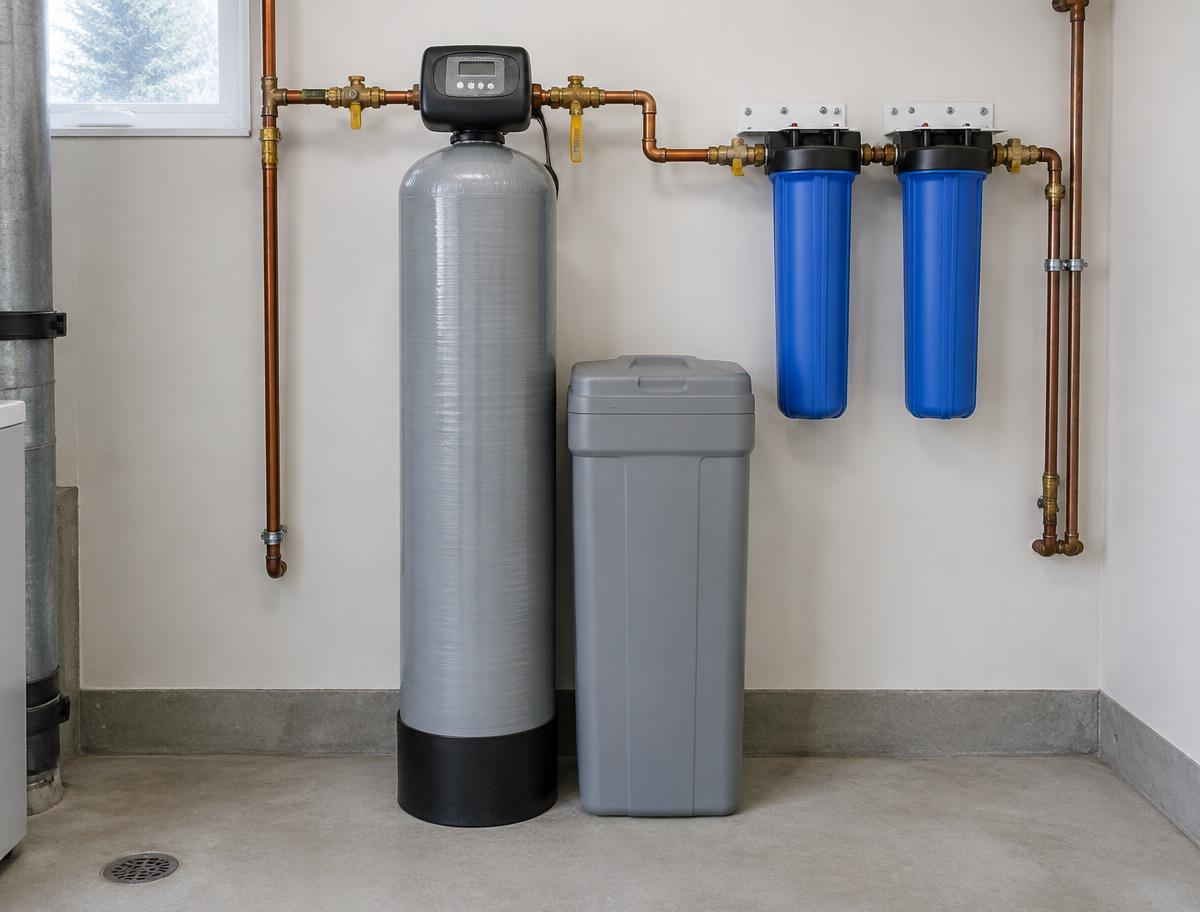
The equipment photograph on this page is a generated illustration, not a completed Plumber Ottawa project. It shows the general appearance of a softener and filter housings; it is not an installation diagram or a recommendation for your home.
Ottawa water treatment guide
How to choose water softening and filtration without overbuying
A useful treatment plan identifies the supply, measures the concern, specifies the equipment and explains how you will maintain it. These questions help you compare options before committing to an installation.
Start with the water source, not the postcode
Ask whether your home receives the central municipal supply, another local municipal system or private-well water. The City publishes drinking-water information, while a private well needs property-specific testing. Neighbourhood descriptions cannot substitute for checking the actual connection and results at your address.
If the problem began suddenly, record when it started and whether neighbours report the same change. A utility notice, recent plumbing work or a malfunctioning existing filter may be more relevant than buying new treatment. Contact the appropriate water supplier about supply concerns before altering the household system.
What hardness results mean
Hardness describes dissolved calcium and magnesium. Ask for a measured value, its units and the sample location. A result reported in milligrams per litre as calcium carbonate is not the same number as a value expressed in grains per gallon. Compare like units when reviewing equipment literature or quotations.
Testing before and after existing treatment helps distinguish untreated-water characteristics from equipment performance. Do not judge softener capacity using a neighbour's machine or a fixture photograph. Hardness, water use and the manufacturer's specifications together inform sizing and regeneration settings; a larger cylinder alone does not guarantee a better result.
Softening is different from drinking-water safety
An ion-exchange softener reduces hardness by exchanging calcium and magnesium for other ions, commonly sodium. That process does not establish that the water is microbiologically safe or remove every dissolved contaminant. A softer feel and less visible scale are not evidence that a safety concern has been resolved.
Health Canada notes the sodium implications of sodium-based softening. Discuss an untreated drinking-water connection or other suitable arrangement if sodium intake is relevant to your household. For medical dietary questions, speak to a qualified health professional rather than relying on a plumbing recommendation or sales claim.
Separate a plumbing assessment from laboratory testing
Before paying for a test, ask exactly which parameters are measured, where the sample is collected and how results are documented. A field hardness check, a bacteria sample and a detailed chemical analysis answer different questions. None should be sold as a universal test for every possible drinking-water hazard.
For private wells, follow the laboratory's sampling and handling instructions. Using the wrong container or collecting a sample incorrectly can undermine the result. Public Health Ontario's well-water program addresses bacterial indicators; it does not replace additional chemical testing when a specific concern requires it. Confirm eligibility and current instructions directly.
Choose whole-house or drinking-water treatment intentionally
Whole-house treatment acts on water entering the plumbing system, while a point-of-use device serves a particular tap. If the concern is taste at the kitchen sink, treating every litre used by toilets and outdoor taps may be unnecessary. If measured hardness affects several appliances, the decision is different.
Map which fixtures should receive treated water and which should bypass it. Ask how the installation will affect the kitchen drinking-water tap, refrigerator supply, outdoor taps and existing appliances. The arrangement should be documented so future repairs do not accidentally connect a bypassed fixture to the wrong branch.
Carbon filters need specific claims and regular replacement
Activated carbon is used in many taste-and-odour filters, but product capability varies. A general carbon label does not prove removal of lead, microorganisms or every other substance. Check the exact model's independently certified reduction claims and operating conditions rather than assuming all cartridges perform the same way.
Cartridge life depends on the model and water use. Keep track of the replacement date and follow the manufacturer's instructions even when the water still tastes acceptable. Ask about replacement availability, housing access and the cost of servicing; a low purchase price can be misleading if consumables are hard to obtain.
Sediment filtration and pressure loss
A sediment filter is intended to capture particles, not to remove every dissolved substance. Its rating, surface area and flow capability matter. An unnecessarily fine cartridge can become restrictive, particularly when several showers or appliances draw water together. Identify the particle source and expected demand before selecting the housing.
If water pressure dropped after a filter was installed, compare pressure and flow around the equipment with professional help. A clogged cartridge, valve position or undersized assembly may be involved. Do not bypass a treatment stage used for a known safety concern without an appropriate plan for safe water use.
Reverse osmosis is a targeted option
A reverse-osmosis system typically treats water at a drinking-water tap and uses a membrane with additional filter stages. Select it for documented needs and the model's certified performance, not because it is presented as the strongest filter. Feed pressure, pretreatment and maintenance affect performance.
Ask about storage capacity, dispensing flow, reject-water drainage and space for cartridge changes. Confirm whether the appliance or refrigerator connection is compatible. Compare the full ownership cost, including membrane replacements and servicing, and avoid promises that a particular system removes all contaminants unless the exact claim is supported.
Private wells may need several separate measures
Private-well quality can change, and a satisfactory past result does not guarantee future results. Keep laboratory records and follow public-health advice for routine sampling and retesting after events such as flooding, repairs or a change in water characteristics. Treatment is only one part of protecting a well supply.
Disinfection equipment such as UV requires suitable water quality and operating conditions. Sediment or other pretreatment may be necessary according to the equipment specification. UV does not remove dissolved minerals, and lamp, sleeve and alarm maintenance matter. Consult public-health guidance if a bacteria result is unsatisfactory rather than merely adjusting a softener.
Plan the installation space and connections
A treatment installation needs accessible pipework, suitable isolation or bypass arrangements and enough room for servicing. Some systems also need power and an appropriate drain connection. Ask who handles any additional electrical work and what local requirements apply; do not assume every basement layout accepts the same equipment.
Leave access to shut-off valves, filter housings and other utility equipment. Consider how consumables will be carried to the system and how spills will be managed. The finished plan should explain drainage and backflow protection where applicable, rather than improvising a hose connection to whichever opening is closest.
Sizing and regeneration affect ongoing costs
A softener's capacity and flow rating should suit both measured hardness and household demand. Ask how peak use, such as overlapping showers and laundry, is handled. Discuss whether the control regenerates based on measured use or a schedule, and how the settings are established for your water.
Ownership includes salt or other specified regenerant, regeneration water, servicing and eventual component replacement. Request realistic operating information from the manufacturer instead of an unsupported savings claim. Correct setup matters more than buying the largest available tank, and a documented maintenance plan makes later performance problems easier to investigate.
Repairing an existing softener or filter
An existing system that performs poorly may have a serviceable fault. Gather the make, model, approximate age, maintenance history and any displayed codes. Compare current test results with previous records. A plumbing assessment can help separate a valve or flow issue from exhausted media or a changed incoming supply.
Ask whether parts remain available and whether repair would restore the intended performance. Replacement may make sense when equipment cannot meet the documented need or servicing is impractical, but age alone is not a complete diagnosis. Request separate explanations for the proposed repair and replacement options before deciding.
Compare complete quotes, not cylinder prices
A useful quote identifies the equipment model, the problem it addresses and the installation work included. Ask about pipe changes, bypass valves, drain arrangements, removal of old equipment and separate trades. Check whether HST and initial consumables are included, and whether laboratory testing is a separate charge.
Ask who provides the equipment warranty, what maintenance is required to keep it valid and what labour coverage, if any, is offered in writing. No particular warranty length is claimed here. Compare ongoing costs and practical service access alongside purchase price; those details can matter long after the installation visit.
Know when equipment is not the first answer
A new filter will not repair a leaking supply line, and softening will not resolve every pressure problem. A dripping tap, a blocked aerator or a failing valve may need a straightforward plumbing repair. Investigate the source of the symptom before combining unrelated work into a treatment purchase.
For boil-water or other drinking-water advisories, follow the issuing authority's instructions. Do not assume an existing filter makes advisory water safe. If a laboratory result raises a health concern, seek appropriate guidance and use a safe alternative supply as directed while the cause and required response are assessed.
Keep useful records after the visit
Keep the test results, equipment model numbers, installation details and maintenance instructions together. Record cartridge or lamp changes and note any water-quality or pressure changes. Those records allow a later technician to compare actual performance with the system's intended role instead of starting from an uncertain history.
Landlords can request written job reports for their property records. In multi-unit buildings, coordinate access and any interruption with management. A household treatment unit should not be represented as proof that every unit's water is safe; sampling scope, shared infrastructure and the equipment's limits still matter.
Explore our Ottawa plumbing network
Plumbing services
- Emergency Plumber Ottawa
- Weekend & Same-Day Plumber
- Plumbing Repairs Ottawa
- Pipe Repair & Replacement Ottawa
- Faucet Repair & Installation Ottawa
- Water Leak Detection Ottawa
- Toilet & Bathroom Fixture Repair
- Kitchen Plumbing & Dishwashers
- Drain Cleaning Ottawa
- Sewer Line Repair Ottawa
- Water Heater Repair Ottawa
- Tankless Water Heater Ottawa
- Plumbing & Heating Ottawa
- Frozen Pipe Repair Ottawa
- Sump Pump Installation Ottawa
- Backwater Valve Installation Ottawa
- Residential Plumber Ottawa
- Commercial Plumber Ottawa
- Plumbing Inspection Ottawa
- Ottawa Plumber Rates & Costs
- Plombier Ottawa (français)
- All Plumbing Services
FAQ
Water softener and filtration questions
Straight answers from our licensed plumbers. Still have a question? Call us — real people answer.
Contact us
Request a water softener or filtration assessment in Ottawa
Send the details and a licensed plumber will call you back with honest advice and a clear, upfront price. For active leaks or no water, call us right away.

Request service or a free quote
Average callback time: under 15 minutes during business hours.